Being in Zambia as part of the BFIRST plastic surgery project was once again a great pleasure; even if getting there was a much lengthier adventure than I hoped for. Many thanks, however, to Emirates for not only getting me to Zambia and back safely, despite the outbreak of war and cancelled flights, but also for funding the flight. Likewise, special thanks to Laura Awad for all her initiative and hard work in securing this Emirates foundation charitable funding for BFIRST.
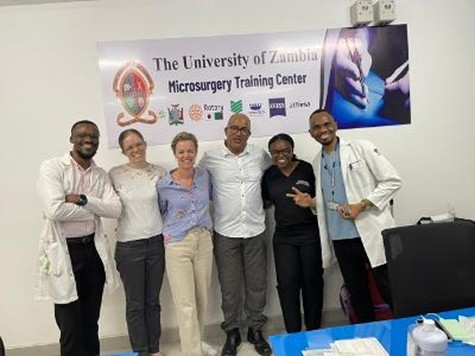
Faculty at the Tendon Repair Workshop
Two hand therapists, Kirsty Van Stormbroek and Nicola Ehlers from South Africa, joined the project this time which, with all their pan African experience in training and clinical initiatives, not to mention their clinical expertise, was such a huge asset. Together we stayed in the hospital apartment where we enjoyed excellent accommodation. Special thanks goes to our Zambian colleagues for organising this.
Returning soon after my last visit had so many advantages: renewing, in person, the friendships I made with the Zambian team, and being ready from the get-go, now that I was already familiar with their systems. Formal teaching of tendon transfers and rehabilitation post tendon repair was also able to start on day one. Knowing the team meant it could be a lot more personalised and collaborative. Likewise, an early start to teaching meant we were able to address the need, highlighted in the last visit, for more opportunities to reinforce and apply the teaching throughout the week.
A highlight of this visit was the midweek tendon repair techniques workshop modelled on surgical training workshops with cost related adaptions. Thanks to Dr Banda for securing the pigs trotters! It meant hand on practice for the trainees and again a truly individualised learning experience.
Alongside formal teaching and training there were plenty of opportunities for more informal collaborative learning in clinical settings. Again, we were able to build on the teamwork already in place with planning and discussion of cases happening together well before my arrival. One challenge we faced was patient’s late presentation; one my Zambian colleagues are only too familiar with, as patients needs far outweighs services. The University Hospital of Lusaka serves patients from all over Zambia; Zambia being the combined size of the Uk and France! Patients, therefore, have to somehow find resources to travel great distances to access care. A heartbreaking example, during the week, was a young woman with a lower arm sarcoma so far advanced it was too late for there to be a successful outcome.
On the more positive side, a patient with longstanding severe hand injuries was admitted during the project week with the first stage of his tendon reconstruction undertaken. This gave us all an excellent opportunity to apply the week’s formal teaching to clinical practice. Moreover, tendon reconstruction is now being planned for this patient. It was very satisfying to see the future benefits of the project come together in these life changing ways.
A final highlight was, on my last day, leading the grand round for no better reason than the arrival of Dr Banda’s baby!
All in all, it was a wonderful privilege to be part of BFIRST’s collaboration in Zambia and to be welcomed back so generously by our Zambian colleagues. Already I am looking forward to returning.