St. Pauls Hospital Addis Ababa January 2026
02 April 2026
(Last updated: 2 Apr 2026 14:13)
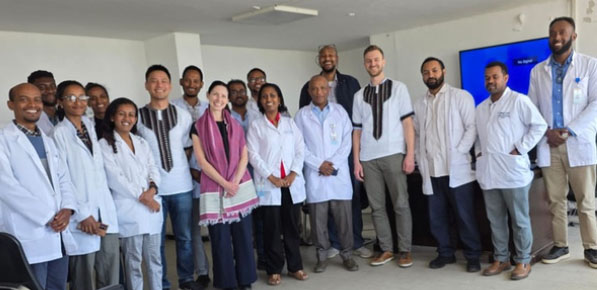
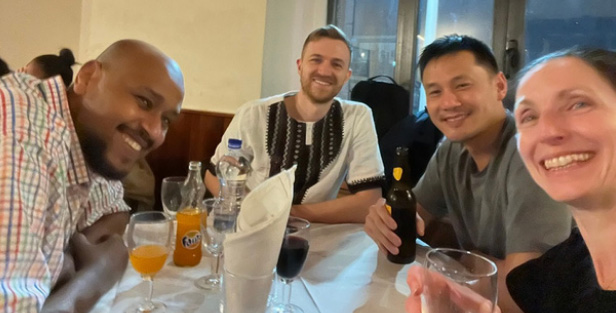 In January 2026, a small team from Stoke Mandeville travelled to Addis Ababa to take part in a collaboration that has been steadily growing over the past several years. The aim was simple but ambitious: to help launch the first dedicated microsurgical training courses for plastic surgery trainees in Ethiopia. What followed was an intense and inspiring week of teaching, operating, problem- solving and shared learning.
Working alongside committed colleagues from St Paul’s, AaBET and ALERT Hospitals, we saw first-hand the determination and ingenuity of surgeons building complex reconstructive services despite significant resource limitations. The visit marked an important step towards establishing sustainable microsurgical training in one of Africa’s key surgical training centres.
The Ethiopian Team
From AaBET and St Paul’s Hospitals:
- Martha Fikramarian – Clinical Director, Department of Plastic Surgery
- Metasebia Mworki – Professor of Plastic Surgery (currently on sabbatical at Ganga
- Hospital, India, and returned for the visit)
- Abeje Brhanu – Microsurgery Lead
- Bereket Atnafu – Consultant Plastic Surgeon
From ALERT Hospital:
- Abraham Gebreegziabher – Consultant Plastic Surgeon
The UK Team, from Stoke Mandeville Hospital
- Rebecca Shirley – Consultant Plastic Surgeon, Stoke Mandeville Hospital
- James Chan – Consultant Plastic Surgeon, Stoke Mandeville Hospital
- Muhanad Adams – Consultant Anaesthetist, Stoke Mandeville Hospital
- Alistair Reed – ST8 Plastic Surgery Trainee, Oxford
Background
The visit built on a scoping trip to Addis Ababa in 2023, when Rebecca Shirley and James Chan first met the Ethiopian plastic surgery teams and began exploring the potential for developing microsurgery training locally.
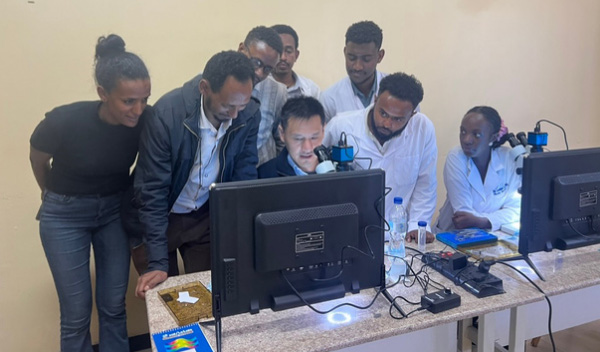 At that time, both ALERT Hospital and St Paul’s Hospital possessed operating microscopes and had begun undertaking microsurgical procedures, although case numbers were still small. Surgeons at St Paul’s and AaBET Hospitals were also performing complex reconstructive procedures using loupes. What was immediately clear was that the clinical demand for microsurgical reconstruction was huge, and the enthusiasm among local surgeons to develop these skills was unmistakable. There were sufficient infrastructure and expertise to develop a microsurgical service safely. A poll conducted in July 2024 reinforced this enthusiasm: all 51 senior residents and faculty members in Addis Ababa expressed interest in attending a microsurgery course. Several surgeons had already travelled abroad for fellowships or observerships in countries including Switzerland, India, Taiwan and South Korea. Ethiopia has the largest number of plastic surgery trainees among COSECSA countries, and Addis Ababa serves as a central training hub for the region. It was therefore an ideal location to establish a microsurgical training facility that could benefit not only Ethiopian surgeons but also trainees from across East, Central and Southern Africa. Following the 2023 visit, BFIRST committed to supporting the creation of a microsurgical training laboratory, made possible through the generous support of two donors.
With donations, we were able to purchase 6 practising microscopes, training kits and simulation vessels which were shipped to Addis in April 2025 but delivery had been postponed at customs for various reasons including healthcare strike.
The planned courses would be four hours each, with an emphasis on practical microsurgery with demonstrations, short talks on flap monitoring and case based discussions.
Aims of the Visit
The January 2026 visit had three main aims:
- To strengthen the growing collaboration between the UK and Ethiopian teams
- To launch the first microsurgical training courses in the newly established laboratory
- · support anaesthetic training for microsurgical cases including regional anaesthetic
- techniques
Itinerary
The visit took place over five intensive days.
We arrived on Monday morning and immediately began setting up the new microsurgical skills laboratory at St Paul’s Millennium Hospital.
The microscopes had arrived but remained carefully packed in their boxes. At our request, the local team had left them unopened until our arrival, allowing us to assemble and calibrate them ourselves and ensure that nothing was lost or damaged. We showed them how to set up and look after the kit.
Two members of staff from the surgical training hub had already transported the equipment into the dedicated room at the educational facility and arranged the benches in a layout that encouraged interaction between participants.
Outside the building, a large sign announcing the microsurgical training facility in collaboration with BFIRST had been installed — a small but symbolic moment that captured the excitement surrounding the project.
During the set-up we confirmed that:
- All microscopes were present and functioning
- Instruments had been delivered
- Multi-socket adaptors had been purchased (each microscope requires two plugs)
The room itself was ideal: spacious, well lit, and already furnished with desks and chairs. Over the next few hours we assembled microscopes, unpacked instruments, and tested the equipment. Everything was present except the silicone practice vessels, but fortunately some biological substitutes left behind during a previous American visit were available.
One unexpected challenge was audiovisual equipment: only one screen in the building actually worked. A quick decision was made to purchase additional monitors locally to enable optimal coaching and feedback for delegates.
Later that afternoon we ran an outpatient clinic to see the 2 cases for surgery later on that week and Case based discussions with the local team. Among the patients seen were:
- A child with obstetric brachial plexus injury
- An adult with complete loss of shoulder abduction following a severe anterior shoulder
- degloving injury sustained in a road traffic accident three years earlier
We also travelled to AaBET Hospital to review a paediatric inpatient: a 10-year-old girl with an open tibia–fibula fracture and segmental bone loss, sustained seven weeks previously.
She was scheduled for complex reconstructive surgery later in the week and faced a very real risk of limb loss. The visit allowed discussion with the surgical team regarding operative planning and preparation.
Day Two – A Historic First Course
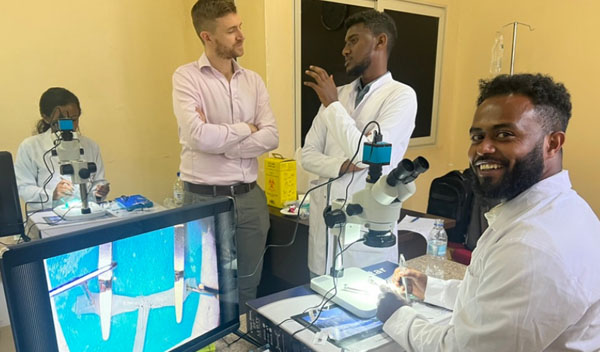 Tuesday marked an important milestone: the first microsurgery training courses ever held in the new laboratory.
Residents from St Paul’s, AaBET and ALERT Hospitals filled the room as the course began at 9am. The atmosphere was focused but excited — many participants were performing microsurgical suturing under a microscope for the first time.
Midway through the morning session, the newly purchased screens arrived. As they were
assembled and switched on, trainees gathered around to watch the first live demonstrations of vessel anastomosis projected across the room. It was a small moment but a significant one — the first time the facility truly came alive.
Teaching was shared between the UK faculty, with Alistair Reed, James Chan and Rebecca Shirley providing demonstrations and short lectures between practical sessions.
Meanwhile, in parallel, Muhanad Adams delivered a full-day course for anaesthetists at St Paul’s Hospital on the practical anatomy of regional anaesthetic blocks. The anaesthetic team already possesses ultrasound machines capable of guiding these techniques, meaning that the knowledge gained can be applied immediately to improve both patient safety and affordability of care.
Participants included residents from St Paul’s, AaBET and ALERT hospitals. Because Ethiopia is a training hub within the COSECSA region, the course has the potential to attract trainees from multiple neighbouring countries in the future.
The enthusiasm in the room was palpable as trainees watched their colleagues perform microsurgical suturing under magnification.
The day concluded with a traditional Ethiopian dinner, accompanied by music, dancing and remarkable displays of cultural performance—including the famous Ethiopian neck-spinning dance. Hospitality was generous and memorable, including the custom of feeding guests large mouthfuls of raw meat as a sign of welcome.
Day Three – Innovation in Theatre
Wednesday was spent in theatre for a complex orthoplastic reconstruction in a child. The orthopaedic team were present in theatre to apply external fixation.
This was a joint case with observers. There has been a case discussion on Monday and again on Wednesday morning in the operating theatre. The case highlighted both the challenges faced by the Ethiopian surgical teams and their remarkable ingenuity in overcoming them. For example, there was no surgical tourniquet available. Instead, the team adapted a blood-pressure cuff — despite a persistent leak — to provide adequate limb occlusion.
The Doppler machine was equally temperamental, working intermittently throughout the day. Yet the team persisted with impressive determination. The anaesthetic plan involved both epidural and general anaesthesia, necessary because multiple donor sites were required. Having spent the previous day teaching regional techniques, Mo was able to work closely with the anaesthetic team to facilitate this safely.
We were also able to donate some instruments and gloves, which proved useful during the procedure. One persistent limitation remains the absence of a dermatome for harvesting skin grafts. Instead, surgeons rely on a Watson knife, which is extremely challenging to use for large burns — particularly in children, whose thin skin is prone to severe scarring.
During our previous visit we donated a Brennen skin mesher, a device that does not require disposable carrier boards and therefore reduces costs. However, access to an electric dermatome would significantly improve the care of patients with extensive burns.
 Day Four – Teaching Becomes Shared
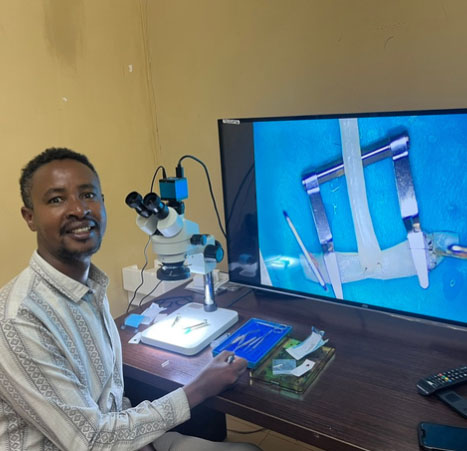
Thursday saw two further microsurgery courses delivered in the training lab.
Residents travelled from ALERT Hospital to participate, and several delegates returned to repeat the course for additional practice.
Encouragingly, Metasebia Mworki and Abeje Brhanu: the Microsurgery Lead, took on the role of teachers, demonstrating techniques and delivering short teaching sessions themselves.
Watching this transition from learners to instructors was one of the most rewarding aspects of the visit.
Day Five – Reflections and Farewell
Our final day arrived all too quickly. There was just enough time for one last visit to theatre, a four hour joint case, with the local surgeons.
 The team performed a bipolar latissimus dorsi transfer to restore shoulder abduction following a road traffic accident. Muhanad Adams once again joined the anaesthetic team, and the collaborative discussion around optimising patient safety was invaluable.
A joint teaching session allowed both teams to share experiences and reflections from the week. It was a fitting conclusion to a visit that had combined training, clinical collaboration and cultural exchange.
Before departing we were presented with beautiful traditional Ethiopian garments, worn only for special occasions. The pride with which they were given was deeply moving — and judging by the many compliments Alistair received on the journey to the airport, they were clearly well chosen. We presented loupes to all the senior trainees.
Read the entire BFIRST Ethiopia report